Top 10 Industrial Warehouse Racking Systems for Small & Large Businesses
Efficient storage is critical for both small and large businesses managing inventory, shipments, and production materials. Industrial warehouse racking systems help optimize space, improve workflow, and enhance safety. Choosing the right racking system depends on your warehouse layout, inventory type, and operational needs. In this guide, we will explore the top 10 industrial warehouse racking systems and their applications, advantages, and considerations.
1. Selective Pallet Racking
Selective pallet racking is one of the most widely used systems for warehouses of all sizes. It allows direct access to each pallet, making it suitable for businesses with varied inventory and frequent product rotation.
Applications:
- Warehouses storing diverse products with different turnover rates
- Distribution centers requiring easy pallet access
Advantages:
- Direct access to any pallet without moving others
- Flexible layout options
- Relatively simple installation
Considerations:
- Requires sufficient aisle space
- Not ideal for very high-density storage
2. Drive-In & Drive-Through Racking
Drive-in racking is designed for high-density storage, where forklifts drive into the rack structure to store or retrieve pallets. Drive-through racking is similar but allows access from both ends, improving throughput.
Applications:
- Seasonal goods or products with lower SKU variety
- Businesses needing maximum storage density
Advantages:
- High storage capacity per square foot
- Cost-effective for large quantities of similar items
Considerations:
- Pallets must be stored using the Last-In-First-Out (LIFO) method for drive-in racks
- Requires careful forklift operation
3. Push-Back Racking
Push-back racking uses a system of carts on inclined rails, allowing pallets to be loaded from the front and pushed back, with retrieval from the front.
Applications:
- Moderate SKU variety with high pallet volume
- Warehouses where space efficiency is important
Advantages:
- Supports Last-In-First-Out (LIFO) inventory management
- Higher storage density than selective racking
- Easy to load and unload
Considerations:
- Initial investment is higher than selective racks
- Not suitable for very fast-moving products needing FIFO
4. Pallet Flow Racking
Pallet flow racking uses gravity rollers to move pallets from the loading end to the picking end, supporting First-In-First-Out (FIFO) inventory rotation.
Applications:
- Perishable goods or products with expiration dates
- High-volume order fulfillment
Advantages:
- FIFO ensures product rotation
- Increases storage efficiency
- Reduces handling time
Considerations:
- More complex installation
- Requires regular maintenance of rollers
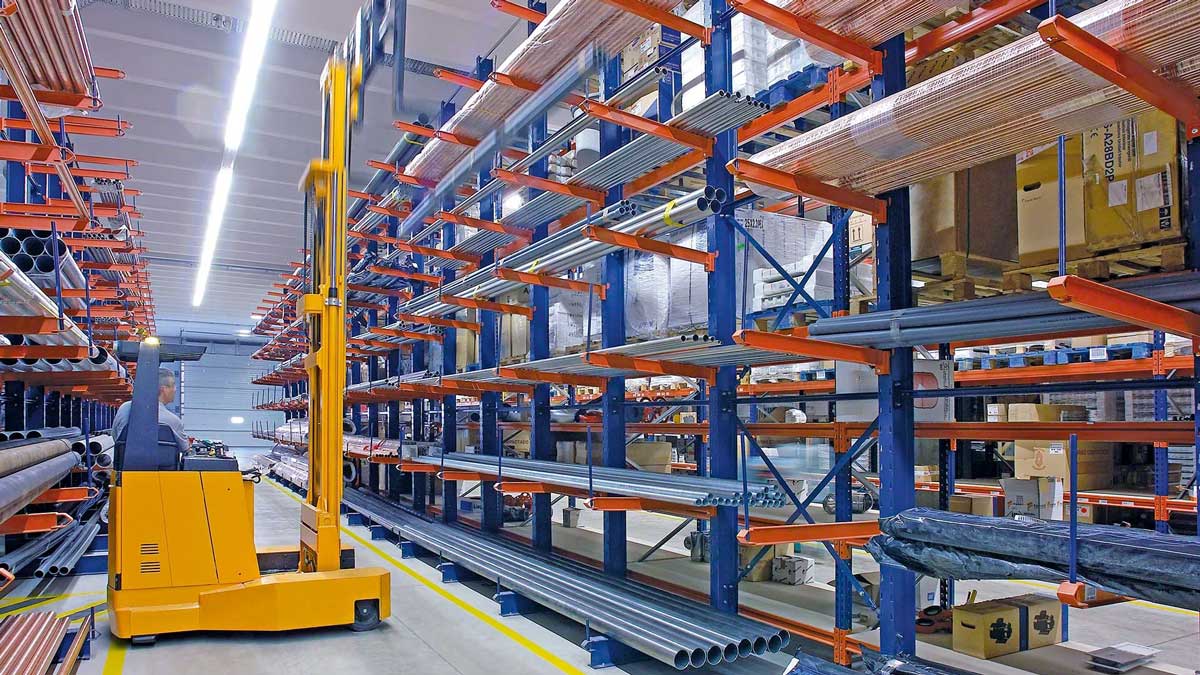
5. Cantilever Racking
Cantilever racking is ideal for long, bulky items such as pipes, lumber, and steel rods. The racks consist of horizontal arms extending from vertical columns.
Applications:
- Construction materials warehouses
- Industries with irregular-shaped products
Advantages:
- Easy to adjust arm heights for different product sizes
- Supports heavy loads
Considerations:
- Less suitable for palletized goods
- Requires adequate floor space
6. Mezzanine Racking
Mezzanine systems add an extra level within a warehouse, creating additional storage or workspace above the floor.
Applications:
- Small warehouses needing more storage without expanding the building
- Businesses requiring office space above storage areas
Advantages:
- Maximizes vertical space
- Can integrate shelving, racking, and office areas
Considerations:
- Structural engineering assessment needed
- Higher upfront cost than standard racks
7. Mobile Racking
Mobile racking consists of shelving or pallet racks mounted on movable carriages, which run on floor tracks.
Applications:
- Warehouses with limited floor space
- Businesses needing flexible storage arrangements
Advantages:
- Eliminates fixed aisles, increasing storage density
- Can be locked for security
Considerations:
- More expensive than static racks
- Requires regular maintenance of tracks and motors
8. Multi-Tier Racking
Multi-tier racking creates multiple levels of storage accessible via stairways or lifts, combining shelving with pallet storage.
Applications:
- Small and medium warehouses requiring dense storage
- Picking operations with high SKU counts
Advantages:
- Efficient use of vertical space
- Customizable for different storage needs
Considerations:
- Requires safety railings and compliance with building codes
- Complex installation
9. Automated Storage & Retrieval Systems (AS/RS)
AS/RS uses automated cranes or shuttles to store and retrieve pallets, ideal for large operations with high throughput.
Applications:
- Large distribution centers
- Warehouses with consistent SKU types
Advantages:
- Reduces labor costs
- High accuracy and speed
- Optimizes space utilization
Considerations:
- High upfront cost
- Maintenance and technical expertise required
10. Shelving Systems for Light Items
Wire shelving, boltless shelving, and other lightweight storage options are ideal for small parts, tools, or retail backstock.
Applications:
- Small businesses or parts warehouses
- Retail storerooms
Advantages:
- Flexible and easy to assemble
- Affordable solution for small inventory
Considerations:
- Not suitable for heavy pallets
- Limited vertical storage density
Choosing the Right Racking System
When selecting a racking system, consider the following factors:
- Inventory type and weight
- Storage density and warehouse layout
- Picking methods and operational workflow
- Budget and installation requirements
By analyzing these factors, businesses can implement a racking system that improves storage efficiency, safety, and workflow management. Even small adjustments in racking design can significantly impact operational productivity.
Conclusion
Industrial warehouse racking systems vary widely to suit different business sizes and needs. From selective pallet racks for versatile access to AS/RS for high-volume automation, selecting the right system ensures efficient storage, smooth operations, and optimized space. Understanding your inventory, operational requirements, and warehouse layout is key to making an informed decision.